
Planar Matryxx™
Ordinary speakers radiate as a point source: output drops off with distance and collides with room acoustics, leaving uneven coverage, poor intelligibility, and no real coherence. Planar Matryxx™ technology (Patents Pending) takes the opposite approach — a planar, long-throw wavefront that propagates evenly across a room of any size, enveloping it in one continuous "sound bath" with the same clarity, accuracy, loudness, and 4-dimensional depth in every seat. We call it Immersive Sound.
Planar Matryxx™ is engineered in two variations — Planar Magnetic Matryxx™, our flagship thin-film transducer arrays, and Planar Dynamic Matryxx™, built on Marziani proprietary full-range dynamic drivers — so the same coordinated-wavefront physics can be matched to any space and any budget.
Invented by Dr. C — Dragoslav Colich, Chief Technology Officer, MARZIANI InMERSION SYSTEMS™
One Immersive Sound Field, not many point sources.
A conventional point-source speaker radiates in all directions, creating spherical waves at low frequencies and a narrower cone at higher ones — strong on-axis, weaker and less accurate off-axis, with every frequency dropping off with distance. That drop-off invites room reflections and acoustic interactions that turn into muddled, non-intelligible sound toward the back of the room. Delay speakers can help, but only partially — the added clarity still fights the original point-source reflections.
Planar Matryxx™ technology replaces that with flat diaphragm panels moving in coordinated phase, so their combined output forms one continuous, uniform wavefront instead of several competing cones — with no loss of clarity or loudness anywhere in the room. The result is a holographic 4D imaging sensation from front to back and clean instrument separation: a group of singers sounds like they're really there. As one listener put it, "the sound is loud, but I can still understand someone talking right next to me." The practical result: no dead zones, no hot spots, and no seat that hears a materially different mix than the one beside it.
Built to Last!
Our MARZIANI InMERSION SYSTEMS™ use reliable high-grade components that work for years without sound degradation. Built for continuous commercial duty — daily shows, nightly sets, year-round installs.
Planar Magnetic Matryxx™ & Planar Dynamic Matryxx™.
Both variations produce the same coordinated Planar Matryxx™ wavefront. They differ in the transducers doing the work — and in how far each is asked to go.
Planar Magnetic Matryxx™
Planar magnetic technology uses a flat, thin membrane suspended in a magnetic field to produce sound. Unlike a traditional cone speaker driven by a central voice coil, the driving force is distributed evenly across the entire surface — delivering exceptionally fast response times and ultra-low distortion.
The Diaphragm
A micro-thin flexible film printed with a serpentine pattern of conductive aluminum or copper traces.
The Magnets
Powerful neodymium magnet arrays placed on both sides of the film, with precise gaps engineered for airflow.
Sound Generation
Audio signals passing through the film traces create electromagnetic fields that interact with the permanent magnets — moving the entire membrane uniformly, as one surface.
Exotic Materials, Everywhere
Cryogenically treated aerospace polyimide film originally engineered for NASA, the highest grade of neodymium magnets (N56) in patented, super-efficient magnetic circuits, machined aluminum stators, force-equalized laser-etched diaphragm circuits, and dynamic diaphragm tensioning.
Very Low Structural Vibration
We don't claim zero vibration of the array structure — only very low vibration, and the reason is mechanical. By Newton's second law (F = m × a), a smaller moving mass produces a smaller reaction force. One transducer moves a diaphragm of roughly 300 mg against a total transducer mass near 3 kg — about 10,000× smaller. That reaction force isn't strong enough to meaningfully excite the much heavier structure around it, unlike a cone-and-voice-coil driver's far heavier moving mass.
When loud, very high quality, high-resolution sound projection is required, Marziani Planar Magnetic™ transducer technology is engineered for exactly this case — across a wide range of room acoustics, room sizes and coverage distances. A no-compromise flagship, priced accordingly.
Planar Dynamic Matryxx™
Planar Dynamic Matryxx™ is built on Marziani proprietary, custom-designed and manufactured full-range dynamic drivers in a small form factor — arranged across a precisely engineered surface for targeted, full-range sound coverage.
It behaves much like our Planar Magnetic Arrays™, trading only a small measure of ultimate resolution — while opening the platform to projects where the flagship isn't in reach.
Low Resonance, Big Excursion
The drivers combine very low resonance with large cone excursion — the foundation for clean, deep output at volume.
Full Range, No Subwoofers
Large arrays play full range on their own — no additional subwoofer enclosures required.
Long-Range, Uniform Coverage
A cost-effective solution for long-range, uniform coverage of spaces of any size.
Breakup is the enemy of detail.
Most loudspeakers rely on cone-and-piston drivers because they're cheap to build at scale — not because they're accurate. Push a cone hard enough and it moves past its linear range: instead of holding a uniform, pistonic motion, the diaphragm flexes and ripples unevenly, like a drumhead struck off-center instead of snapping back as one surface. Engineers call this breakup, and it's the point where loud passages turn overdriven and smeared instead of clean.
Planar Matryxx™ solves it by spreading the work across a matrix of many smaller drivers instead of asking one large cone to do it alone. Every element in the matrix is driven with uniform planar force, so the whole surface moves together — almost perfectly pistonic, even at volume. The result is vanishingly low distortion and detail that stays intact from a whisper to a wall of sound.
Conventional cone driver
Non-linear excursion at volume causes mechanical breakup and local resonance across the diaphragm.
Planar Matryxx™
Uniform planar force across the entire matrix — the whole surface moves as one, not many.
Three trade-offs, solved by the same matrix.
Deep bass, precise imaging, and fast transient response usually come at each other's expense. Planar Matryxx™ doesn't trade one for another — the same coordinated matrix delivers all three.
Real bass, without the strain
Deep bass means moving a lot of air. Conventional drivers do it with one large diaphragm pushed to high excursion — introducing heat, stress, and distortion at volume. Matryxx spreads that work across a large matrix of smaller drivers instead, delivering bass that's deep and powerful without sacrificing clarity.
Imaging you can point to
Small cone diaphragms radiate in a spherical pattern the brain reads as unnatural, making it harder to place where a sound is coming from. A large Matryxx panel generates a flat, planar wavefront instead, so instruments and voices land exactly where they belong in the room.
Speed that keeps up
Force equals mass times acceleration — the lighter the diaphragm, the faster it starts and stops. Matryxx panels stay far lighter than a high-excursion cone, so they track a snare hit or a piano attack with a speed heavier drivers can't match.
Why fragmented sound breaks immersion.
A room full of individually-aimed speakers can still sound impressive standing in the right spot. It's every other spot that gives it away. In the animations below, red is high air pressure and blue is low air pressure — the gradient colors in between represent lower levels of pressure.
Point-Source
BeforeIndependent sources, each firing on its own schedule. The interference is unpredictable — hot spots and dead zones shift constantly, and there's no seat that's reliably good.
Planar Matryxx™
AfterPlanar Matryxx™, firing in identical phase. The wavefronts merge into one flat plane that moves straight outward, with no fading as it travels.
Sources pulling into phase
Before → AfterThe same five sources, brought into phase. As their timing converges, the competing pressure pockets collapse and the field resolves into parallel wavefronts moving straight out from the array. The clip runs forward and then back, so the contrast builds and breaks continuously.
Pressure as terrain.
The same two fields, rendered as a 3D surface — height is instantaneous sound pressure. Chaos reads as chop. Coherence reads as one clean wave rolling toward you.
Point-Source
BeforeThe same independent sources, seen as a surface. Pressure spikes and collapses at random — a choppy, unstable sea with no repeatable shape anywhere.
Planar Dynamic Matryxx™
AfterThe coordinated Matryxx line, seen as a surface. Every crest is one straight, uniform wave that travels forward without breaking apart or fading.
Big sound from small amplifiers.
Planar Matryxx™ needs far less amplifier power than conventional systems, for two compounding reasons: very high array efficiency — 105 dB from a single watt, measured at one meter — and very low SPL drop with distance, because a planar wavefront doesn't thin out the way a point source does. Expect only a 5–6 dB drop at 10 meters, where a point source loses 20 dB. And loudness is expensive for point sources: every 20 dB of SPL costs 100× the amplifier power.
Worked Example: 110 dB at 10 Meters
10 WBoth solid curves start from the same 105 dB (1 W / 1 m) array efficiency, driven with 10 watts. To deliver 110 dB at 10 m, the array only has to produce 115 dB at 1 m — and 105 dB + 10 dB of drive is just 10 W of amplifier power. The same 10 watts through a point source arrives at only 95 dB. For a point source to land on the array's 110 dB (dashed curve), it must produce ≈130 dB at 1 m — and every 20 dB of SPL costs 100× the power. From a typical 90 dB (1 W / 1 m) speaker that's around 10,000 watts: a driver pushed that hard is deep into gross distortion long before it burns out. Even granted the array's own 105 dB efficiency, it would still take over 300 W to Matryxx's 10.
Loud, clean, and sustainable — not an arms race.
The chart above is the whole argument in one image: a Planar Matryxx™ array reaches its target loudness at the back of the room without ever overdriving the front. That's a deliberate design goal, and it's worth spelling out why it matters.
Our target: 110–115 dB, sustained
We engineer to a specific, honest number: 110–115 dB of full-range, distortion-free coverage across the whole venue — loud enough to fill a room with real presence and impact. That's a deliberate design target, not a peak figure pulled from a spec sheet. It's increasingly common to see systems advertised at 144–150 dB max output; numbers in that range don't demonstrate quality, they demonstrate a level that can damage hearing in minutes.
Why other systems run hotter up front
A point-source system loses volume fast with distance, so the only way to hit an acceptable level at the back of the room is to massively overdrive the front. That puts the people closest to the stage under the most punishing SPL of the night — for reasons that have nothing to do with the music and everything to do with coverage math.
The room itself starts making noise
Push a room hard enough and it stops being just the speakers you're hearing. Windows and doors rattle, roof structures resonate, light fixtures buzz — all of it layering onto the program material and making the overall sound noticeably dirtier. Because a Planar Matryxx™ field never needs that same near-field overdrive, this room-borne noise is minimized or absent entirely.
Full concert. Full conversation. That's Planar Matryxx™.
Two guests can stand right in front of a full-volume Planar Matryxx™ array at concert output and hold a completely normal conversation — no shouting, no leaning in — then keep talking easily as they walk through the crowd. That's possible for two concrete reasons, not a mystery: the array never has to overdrive the front just to cover the back of the room (see above), so the pressure at the source isn't the chaotic near-field blast a legacy rig produces to compensate for coverage loss. And because distortion is near-zero, there's very little extra noise energy sitting in the same frequency range as a human voice — so a nearby conversation doesn't get masked the way it would over a harsh signal at the same volume. Loud is still loud. It's just clean enough to talk over.
One technology. Two ways to build it.
Planar Matryxx™ is the Marziani technology family: sound launched from one coordinated radiating plane instead of a collection of point sources. It comes in two variations — Planar Magnetic Matryxx™ and Planar Dynamic Matryxx™ — matched to different rooms, ranges, and budgets.
Planar Magnetic Matryxx™
A micro-thin film — cryogenically treated aerospace polyimide originally developed for NASA, laser-etched with force-equalized conductive traces — is suspended between patented arrays of N56 neodymium magnets and machined aluminum stators. Signal through the traces moves the entire membrane as one: the driving force is spread evenly across the whole surface rather than concentrated at a voice coil, for exceptionally fast response and ultra-low distortion, radiating as a dipole for an open, spacious soundstage.
Each 5×10-inch panel moves enough air to launch a planar wave from 100 Hz, and the near-massless film extends to 40 kHz — no traditional woofer enclosure in the path. In large arrays it is our recommended configuration when loud, high-resolution projection is required across difficult room acoustics or long distances: large arrays have been tested at ranges up to a mile with low distortion and spectacular imaging. Its one real downside is cost — this is the premium tier.
Cryo-treated aerospace polyimide film · N56 neodymium magnet arrays · patented magnetic circuits · machined aluminum stators · laser-etched, force-equalized diaphragm circuits · dynamic diaphragm tensioning · dipole radiation · 100 Hz – 40 kHz per panel
Flanking a Subwoofer Wall
Magnetic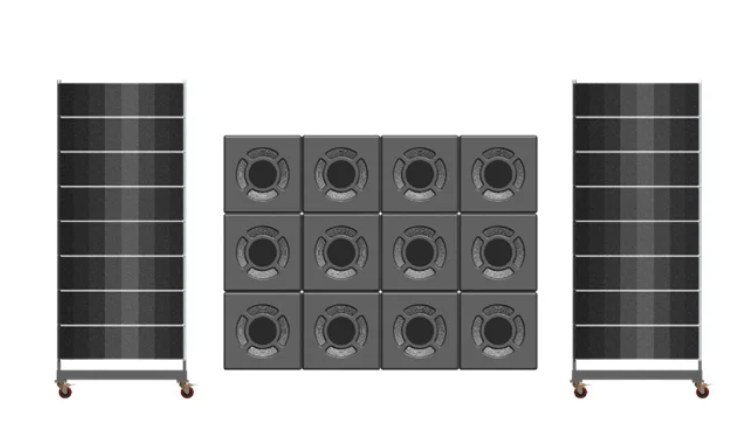
Planar Magnetic Matryxx™ panels flanking a twelve-cube Marziani subwoofer wall: the arrays carry the wavefront from 100 Hz up; below that, the wall takes over.
Tower Configuration
Magnetic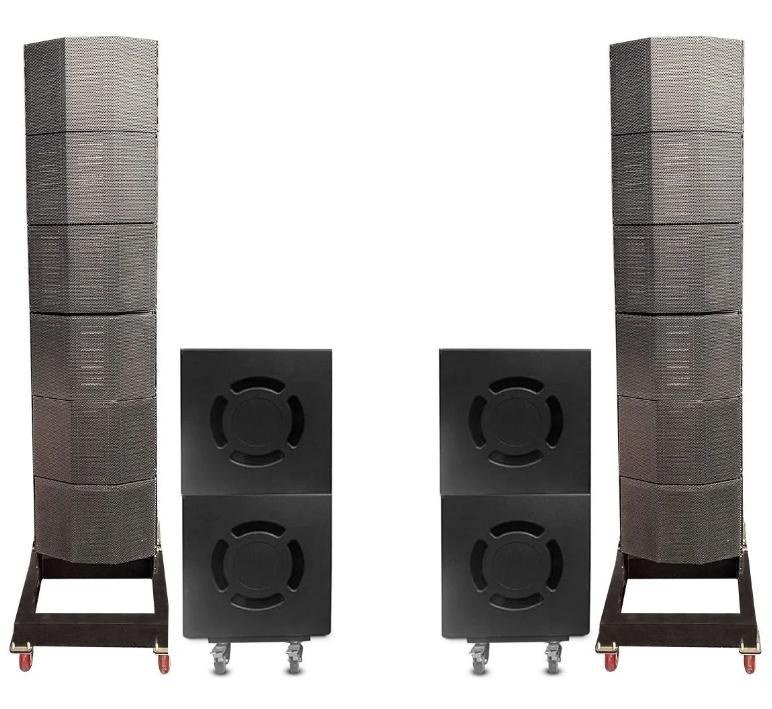
Planar Magnetic Matryxx™ towers on mobile bases, each paired with a stacked subwoofer column — the same physics in a footprint that rolls into place.
Planar Dynamic Matryxx™
Patents-pending arrays of Marziani-proprietary, custom-designed and manufactured full-range dynamic drivers, engineered so the array behaves like a single planar surface: low driver resonance, large air displacement, and extremely-low-distortion, long-throw planar waves. At extreme volume it concedes only slightly more distortion than its Planar Magnetic sibling — and large Dynamic arrays play full-range with no subwoofers required. It is the cost-effective way to put long-throw, uniform, low-distortion coverage into any size space.
Dispersion is controlled deliberately rather than left to the cabinet's shape: horizontal coverage holds to roughly ±30° (60° total) for wide, even coverage across the seating area, while vertical dispersion is tightly controlled to cut down floor and ceiling reflections. For flown, line-array-style configurations, cabinets can be splayed up to 10° in 2.5° increments to shape vertical coverage to the room. Arrays support both parallel and series wiring, giving installers flexibility to match impedance across complex multi-panel configurations.
Patents pending · proprietary full-range drivers · low resonance · large air displacement · full-range in large arrays — no subwoofers required · ±30° horizontal dispersion · up to 10° flown array splay · parallel/series array wiring
Full-Face Driver Matrix
Dynamic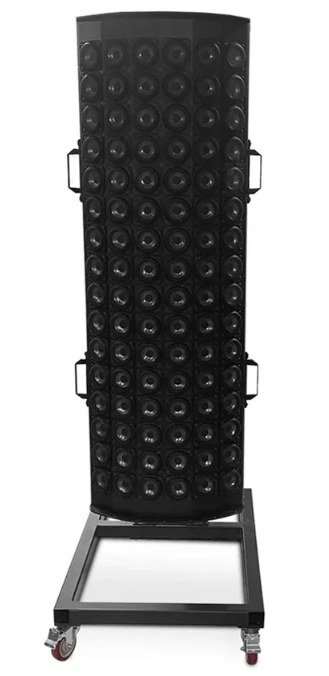
Planar Dynamic Matryxx™ panel — dynamic drivers packed edge to edge so the whole face radiates as one, on a rolling stand.
Array Over Subwoofer Stack
Dynamic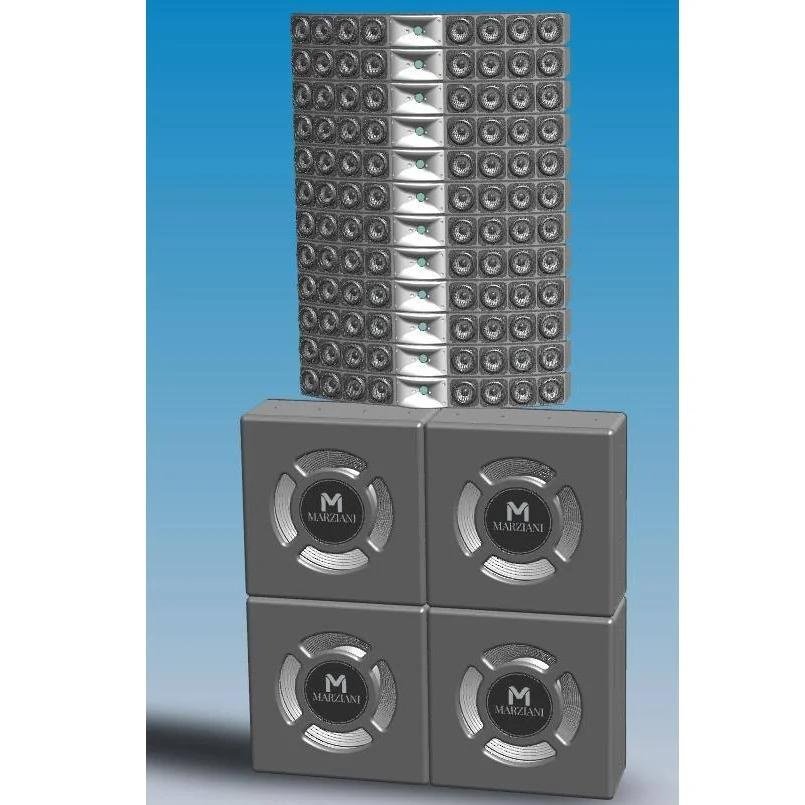
Engineering render: Planar Dynamic Matryxx™ array — horn-loaded high-frequency columns over an optional four-cube Marziani subwoofer stack. Large Dynamic arrays run full-range on their own.
"Uncompromised Audio" isn't a slogan. It's an obsession.
Every model we build carries the same signature: pure, pristine sound that stays three-dimensionally precise at long distances, with every note and subtle detail intact — whether you're a passionate audiophile or running a demanding professional install.
Clarity gives you room to turn it down.
Why loud sound feels tiring
A lot of what makes loud audio fatiguing isn't the volume itself — it's distortion. When a system is pushed past its clean range, harsh artificial harmonics get layered onto the signal, and the ear and brain have to work harder to parse them out. That extra processing load is a big part of what people register as "ear fatigue" after a long show.
What low distortion changes
Because Planar Matryxx™ stays clean at the SPL levels a typical install actually needs, dialogue and detail come through clearly without being pushed to the edge of the system's range. That headroom means an operator doesn't have to run the system as loud to be heard clearly — and for any sound system, running lower is generally kinder to hearing over a long day.
Standard practice still applies
This isn't a claim that any SPL becomes "safe" — sound pressure level is still the primary factor in hearing health, and standard exposure guidelines and hearing protection practices apply exactly as they would with any system. The benefit is narrower and more practical: a cleaner signal gives you the option to run quieter without losing clarity.
Sound doesn't leave a speaker as a beam. It leaves as a balloon.
Acousticians describe a loudspeaker's coverage as a balloon: measure how loud the speaker is at every angle around it, and plot that level as distance from the center. It's the flat polar plot taken into 3D — the peak at the top of the 2D plot becomes the nose of the balloon — so you can see sound radiation in all directions at once. Each balloon describes one specific frequency, and the shape changes dramatically from band to band. In the renderings below, red is high output level and blue is low output level — the gradient colors in between represent lower levels of output. The faint dotted sphere is the 0 dB reference: the balloon a perfectly omnidirectional source would fill.
One Balloon Per Frequency Band
125 HzOne balloon per frequency — and the shape changes dramatically across the range. At low frequencies it's nearly a sphere, kissing the 0 dB reference in every direction: bass wraps around the cabinet and fills the room. As the band rises, the balloon collapses into a forward lobe anchored at the on-axis nose: the speaker grows more directional, and seats off to the side hear a duller version of the mix.
Most published balloons are estimates.
Measuring a full balloon is hard, so a common industry shortcut is to measure just two polar slices — one horizontal, one vertical, at fixed angular increments — and mathematically interpolate everything in between. As the SynAudCon article linked below puts it, that's like describing an apple with a bite taken out of it from two thin slices: if the bite doesn't touch a slice, it never shows up. Everything below is shown at the 2 kHz crossover band, where the risk of estimation error peaks.
The Raw Data: Two Polar Slices
5° incrementsA polar plot is the flat projection of one slice through the balloon — distance from center is output level at that angle, with on-axis at the top. Gold is the horizontal slice and blue is the vertical, captured point by point as the rig sweeps around the speaker. These two curves are typically the only data collected; the balloons below are built from them. The topmost point of the plot — on-axis — is the nose of every balloon on this page.
Interpolated
EstimatedOnly the two bright rings — the same horizontal and vertical polars plotted above — are real data. Every other point on this smooth, confident surface is estimated from them — the model literally cannot show a problem that sits between the slices.
Fully Measured
MeasuredThe same speaker with every angle actually measured. Off-axis dips and lobes were there all along, sitting exactly between the two slices — the interpolated balloon simply couldn't see them.
Concept & measurement background: "Interpolated Balloons" — Jeremy Johnston, SynAudCon / ProSoundTraining
Every install is tuned in the room it lives in.
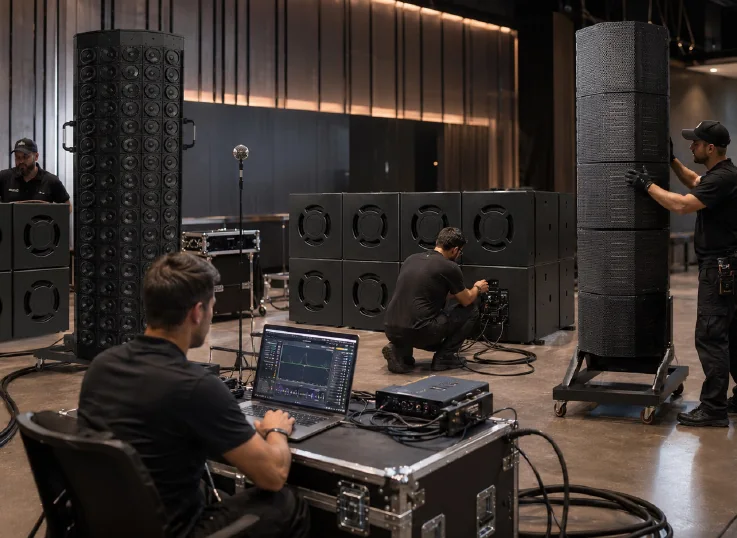 Commissioning session — transfer-function capture
The same rigor, on site. Bench-testing every unit is half the job — the other half is measuring the finished room. During commissioning our engineers capture the array's actual in-room response with calibrated microphones and transfer-function analysis, then tune the field to the space as built, not the space as drawn.
Bring us your floor plan.
Our team will map the field to your footprint before you commit to a system.
Book a Consultation