
 Evidence Review
The Cognitive Cost of Bad Sound
You track sleep, light, glucose, training load and HRV. You have never measured the one environmental input your nervous system cannot switch off. Flow State Audio™ is our name for fixing that — a specified acoustic environment rather than a treatment. This is the evidence behind it: what the literature supports about degraded audio, listening effort and attention, where it runs out, the claims we refuse to make, and a study we would like someone to run.
How to read this page
Every claim below carries a label. Measured means our own bench data. Established means published, replicated science with citations. Inference means a reasonable extension that has not been directly tested — including our central one. Not supported means we looked and the evidence isn’t there.
We publish the labels because our audience checks. If you only read one section, read Section 09 — what we do not claim.
Sound Is the Last Unaudited Input
The self-optimization audience measures sleep, light exposure, air quality, glucose, training load, and heart-rate variability. Sound is anomalous in that list: a continuous physical input, pressure waves arriving at the cochlea for most of the waking day, that cannot be voluntarily gated.
The visual system has eyelids. The auditory system has no equivalent. Auditory processing continues during sleep, which is precisely why noise disturbs sleep architecture without waking the sleeper.
Two properties make sound a legitimate optimization target. Processing is obligatory — the auditory brainstem and cortex handle incoming sound whether or not it is attended, and salient or degraded signals recruit attention involuntarily. And exposure is chronic — a typical knowledge worker spends eight to twelve hours daily in acoustic environments they did not design, listening through transducers they have never evaluated beyond loudness and price.
“Sound is the last unaudited input” is a framing device rather than a scientific finding. We think it is a fair one.
The Wellness Stack Has a Hole In It
Walk into any serious wellness property built in the last three years and you will find a broadly standard set of environmental interventions: contrast therapy circuits pairing sauna with cold plunge, red-light panels, cryotherapy, hyperbaric oxygen, halotherapy salt rooms, circadian lighting, air and water filtration. Each is an input to the nervous system, deliberately dosed. That is the whole logic of the category — you do not leave the physiological environment to chance, you specify it.
Now count how many of those properties specify their acoustic environment with the same rigour. Not the music playlist. The transducers, the coverage, the distortion at the listening position, the level uniformity between the front of the room and the back.
The gap, stated plainly
You can book a room where the light temperature is programmed to the hour, the water is triple-filtered, the air is HEPA-scrubbed and the cold plunge is held to a degree — and then sit in that room all day listening through a speaker nobody ever measured. Sound is the one environmental input the wellness industry sells an experience of, without auditing it as an input.
This is not because the science is missing
Acoustic quality is already treated as a health variable in the built environment. The WELL Building Standard — the certification used across workplaces, healthcare and hospitality — carries a dedicated Sound concept covering background noise levels, reverberation time, sound-reducing surfaces, speech privacy and acoustic zoning, on the explicit basis that occupant health and cognitive performance depend on them. The International WELL Building Institute cites survey work in which nearly all respondents reported impaired concentration attributable to poor acoustic comfort.
So the built-environment world already accepts the premise. The wellness-hospitality world has largely not imported it — sound remains programmed as atmosphere rather than specified as dose.
“Sound hygiene” already exists — in the wrong department
The term is not ours. It has been used for years in acoustics education and hearing conservation, where it means understanding sound level, exposure duration and masking well enough to protect the auditory system. That work is real and it matters. But it is framed almost entirely around preventing damage — dose limits, safe-listening durations, hearing loss.
What it has not been extended to is the far more common, entirely sub-clinical case: sound that will never damage your hearing, but that your brain is quietly working harder to decode, eight hours a day, for years. Nobody is issuing a hearing-loss warning about a mediocre conference-room speaker. That is precisely why it goes unaudited.
The timing is not accidental
The Global Wellness Summit’s 2026 trends forecast names the rise of neurowellness — nervous-system regulation as the sector’s next frontier, spanning consumer neurotech through somatic practice — alongside a countervailing over-optimization backlash against endless tracking and scoring.
Sound sits in an unusual position between those two trends. It is a genuine nervous-system input, which is the neurowellness case. But addressing it requires no wearable, no protocol, no daily metric and no discipline from the guest — you fix the room once and everyone in it benefits passively, forever. It is one of the few interventions that answers the optimization backlash by removing a load rather than adding a practice.
We think that makes it the most obviously missing item in the wellness stack, and the argument for it does not require a single claim beyond the evidence set out in the rest of this page.
Flow State Audio™ for Wellness Resorts
Flow State Audio™ is our name for a specified acoustic environment: a room where reproduced sound is clean enough and even enough that the auditory system stops working to reconstruct it. It is not a treatment, a session, or a modality. It is a property of the building, and it runs whether or not anyone books it.
First, the objection every spa director will raise
“We already do sound.” And that is true. Sound baths are among the most widely offered wellness experiences in the world — crystal singing bowls, gongs, chimes, floating sessions in a warm pool, vibroacoustic loungers. They appear on the menu at destination spas, desert resorts and urban bathhouses alike, typically as forty-five to ninety minute sessions priced between roughly $65 and $215.
So the category has not ignored sound. It has done something more interesting: it has made sound a ceremony — and left the acoustic environment unspecified.
The distinction that matters commercially
A sound bath is a scheduled event, forty-five minutes long, that a guest books, pays for, and attends once. The acoustic environment is the other twenty-three hours — arrival, treatment rooms, the movement studio, the recovery lounge, the restaurant, the guest room. Nobody has written a specification for those.
Sound is on the menu. It is not in the spec.

And a difference in what gets claimed
We should be straight about this, because it is the reason a property might prefer working with us. Sound-healing services are routinely marketed with physiological and energetic claims that the published evidence does not support.
We make no claims of that kind, and we never will. Section 09 sets out precisely which ones we examined and rejected, and why — including the entrainment claims common in this category, which we consider physically unavailable to any room loudspeaker regardless of how well the technique works in principle.
For an operator, that is not a philosophical difference. It is a regulatory and reputational one. A property can promote a specified acoustic environment on the basis of acoustics and attention without making a single health claim, and without exposure if a guest, a journalist or a regulator decides to check the science behind it. The evidence on this page is the evidence, and the labels are already on it.
What we would actually specify
Not a product list — a set of properties, per zone, that an operator can hold a vendor to:
| Zone | What matters acoustically | Why |
|---|---|---|
| Arrival & lounge | Even level front to back; no hot seat under a driver, no dead corner | Coverage nonuniformity is why staff creep the master level up all day |
| Treatment rooms | Low distortion at low level; controlled reflections; no bleed between rooms | A guest lying still with eyes closed has nothing to attend to except the sound |
| Movement & studio | Intelligibility at the back without raising level at the front | Instruction has to carry without the front row paying for it |
| Recovery & contrast circuit | Uniform, low-effort field across a large wet room | Hard tiled surfaces are the worst case for reflection smear |
| Restaurant | Speech privacy and a low background floor | The most common acoustic complaint in hospitality, full stop |
| Guest room | Clean reproduction at conversational level | Where the majority of the twenty-three hours is actually spent |
Several of these already map onto the WELL Sound concept — background noise levels, reverberation time, acoustic zoning, speech privacy. A property pursuing WELL certification is doing part of this work already, usually without connecting it to the guest experience it is selling.
Why it suits an operator better than another device
No protocol, no staff training
Nothing to schedule, nothing to explain, no practitioner to certify. The environment is either specified or it isn’t.
Benefits every guest passively
Including the ones who booked nothing, which is most of them. Utilisation is one hundred per cent by construction.
It does not age out
Industry analysis of high-tech spa amenities has found utilisation collapsing after the first year as the next device arrives. Acoustics is building fabric, not a gadget.
It answers the optimisation backlash
The 2026 wellness forecast identifies fatigue with constant tracking and scoring. This is an intervention that removes a load rather than adding a practice.

What we will not tell your guests
That it heals them, rebalances them, alters their neural rhythms, or puts them into flow. What we will say is narrower and defensible: a sound field this clean and this even asks less of the auditory system, and attention that is not being spent on reconstruction is available for something else. That claim is set out in full, with its evidence and its limits, in the sections above and below.
If you operate or are designing a property and want the acoustic environment specified rather than assumed, talk to our team. We would rather scope a real room than send a brochure.
What “Degraded Audio” Actually Means
Precision matters here, because the literature treats different degradations differently. Four distinct mechanisms sit between the source file and your eardrum.
| Mechanism | What happens |
|---|---|
| Harmonic & intermodulation distortion the transducer | A driver distorts when its motion stops being proportional to the input. The dominant cause in conventional designs is long cone excursion: to produce high SPL from a small radiating area, the cone must travel far and fast, leaving the linear region of its suspension and motor. The output then contains harmonics and intermodulation products that were never in the source. |
| Comb filtering & reflection smear the room | You receive the direct sound plus delayed copies off ceiling, walls, floor, desk and windows. These interfere — adding at some frequencies, cancelling at others — producing a ragged, position-dependent response and temporal smearing of transients. This degrades the signal at the ear even when the loudspeaker itself is clean. |
| Point-source geometry coverage | A conventional loudspeaker approximates a point source: level falls roughly 6 dB per doubling of distance. That produces a hot zone near the source and dead zones away from it. There is no single correct volume setting; every position receives a different level and spectral balance. |
| Ambient noise the environment | HVAC, traffic and appliances raise the floor against which any signal must be decoded — forcing either higher playback levels (more excursion, more distortion) or worse signal-to-noise (more listening effort). |
Degraded Sound Is Measurable Cognitive Work
Established science
Listening effort is a formalized research construct
Audiology defines listening effort as the deliberate allocation of mental resources to overcome obstacles in goal pursuit during a listening task — the FUEL framework (Pichora-Fuller et al., 2016, Ear and Hearing), which builds explicitly on Kahneman’s capacity model of attention. This is not a marketing coinage. It is the organizing construct of a substantial research programme with dedicated measurement methods.
It is objectively measurable — the pupil gives it away
Task-evoked pupillometry is the most widely used objective index. The pupil dilates under cognitive load through locus coeruleus–mediated arousal, independent of light level. Findings replicated across dozens of studies:
• Degraded signal quality, greater task complexity, and hearing impairment all produce larger pupil dilation, reflecting greater cognitive load (Zekveld et al., 2010; 2014; Winn et al., 2018).
• Critically, effort can rise while intelligibility stays constant. Different degradation types — noise versus reverberation — produce different pupil responses even at matched comprehension (Koelewijn et al., 2014). Performance can look identical from the outside while the cost goes up.
• Resolving the mismatch between a degraded signal and its canonical form draws on a finite pool of cognitive resources, leaving fewer for concurrent tasks (Zhang et al., 2020, PLOS ONE).
EEG corroborates the cost — and complicates the marketing
Acoustic degradation combined with memory load amplifies alpha-band activity during word processing, interpreted as increased inhibitory and effort demand (Obleser et al., 2012).
Note the irony, because it matters for how this field gets misused: in the listening-effort literature, more alpha in task contexts often indexes more suppression work — not blissful relaxation. Alpha is context-dependent: the same band that marks calm, eyes-closed rest in one condition indexes cognitive suppression work in another, and rises again in drowsy disengagement. Any product claim built on “more alpha is better” misreads this literature rather than extending it.
Fatigue is the downstream consequence
Hornsby (2013) and successors show degraded listening conditions produce measurable listening-related fatigue over sustained sessions. The chain — degraded input, reconstruction effort, resource depletion, fatigue and disengagement — is well supported for speech in noise.
The honest limit of Pillar One
Most listening-effort research studies speech in noise, frequently in hearing-impaired listeners. Direct studies of loudspeaker harmonic distortion on cognitive load are sparse, and adjacent findings are supportive but mixed.
There is no published study on loudspeaker distortion and flow states specifically, and none on Planar Matryxx™. The correct verb in our material is “plausibly extends,” never “proves.”
Noise Is a Physiological Stressor
Established science
This is the most institutionally validated part of the argument.
Under the Babisch noise-reaction model, chronic low-level noise disturbs activity, communication and sleep, triggering annoyance and stress; the body activates the HPA axis and sympathetic nervous system, releasing catecholamines and cortisol (Hahad et al., 2019).
Chronic noise stress is associated with elevated blood pressure, dyslipidemia, raised blood glucose and clotting activation, and persistent exposure increases risk of hypertension, coronary artery disease, type 2 diabetes and stroke (Münzel et al., 2018; Basner et al., 2014, The Lancet). Experimental night-time aircraft-noise exposure induces endothelial dysfunction in healthy subjects, mitigated by vitamin C — implicating oxidative stress mechanistically (Schmidt et al., 2013, European Heart Journal). The WHO Environmental Noise Guidelines (2018) treat environmental noise as a leading environmental health risk in Europe.
The honest limit of Pillar Two
This literature concerns environmental noise dose — levels, night-time exposure, annoyance — not playback fidelity. It establishes that sound is a physiologically active input rather than a neutral backdrop, and it supports uniform-coverage arguments, since a system that is intelligible everywhere at lower level reduces the pressure to run louder. It cannot be cited as evidence that loudspeaker distortion causes heart disease, and we do not cite it that way.
The office-noise evidence shows the same signature
A controlled simulated-office study comparing a typical open-plan auditory environment against a quieter private office found elevated heart rate and skin-conductance response, and measurably worse mood, with no significant difference in immediate proofreading accuracy. Earlier work by Jahncke and colleagues found poorer word recall, higher self-rated tiredness and lower motivation under higher open-plan noise.
Note the pattern, because it recurs throughout this page: the cost was real and physiological, and the performance measure did not reveal it. This is the same signature pupillometry finds in degraded listening, arrived at from a completely different literature.
Flow, Attention, and the Budget Argument
Flow (Csikszentmihalyi, 1975; 1990) has well-characterized preconditions: clear goals, immediate feedback, challenge–skill balance, and complete, undivided concentration. Phenomenologically it involves a drop in self-monitoring and a distorted sense of elapsed time. Interruption research shows task switches and even brief interruptions measurably degrade performance and raise error rates (Altmann et al., 2014).
Kahneman’s capacity model — the same model FUEL builds on — treats attention as a finite budget allocated across concurrent demands. That is the load-bearing joint of this entire argument:
| Step | Support |
|---|---|
| 1. Flow requires undivided attention | Flow literature Established |
| 2. Attention is capacity-limited | Cognitive psychology Established |
| 3. Degraded auditory input recruits cognitive resources involuntarily | Listening-effort literature Established |
| 4. Therefore degraded audio competes with flow for the same finite resource | Follows from 1–3, but not directly tested Inference |
Steps one through three are individually well supported. Step four is a reasonable inference awaiting direct test, and we state it exactly that way everywhere.
The EEG picture of flow, accurately
The neuroscience of flow is younger and messier than the psychology. Findings include frontal theta increases, some reports of moderate frontal alpha (the transient hypofrontality hypothesis — Dietrich, 2004), and reduced default-mode-network activity during absorbed states.
There is no single “flow frequency.” Flow is a whole-network configuration, not a band you can broadcast into someone’s head. Claims that a speaker “puts your brain in a flow-state frequency” contradict this literature rather than extending it.
Why This Matters If You Optimize Everything Else
The self-optimization audience has already accepted the central premise of this page — that environment is an input worth engineering rather than a backdrop to tolerate. The standard flow-environment checklist covers colour temperature and lux, ambient temperature held in a narrow band, notification suppression, single-tasking, timed work blocks, and challenge calibrated just past current skill.
Sound appears on that checklist too, but almost always in one of two forms: masking — white, pink or brown noise to cover intrusions — or entrainment, meaning binaural beats and isochronic tones. Both treat sound as something you add to the environment to produce an effect.
We are making the opposite argument
Masking and entrainment are attempts to use sound as an active intervention. Our claim concerns the sound that is already there and is already costing you something — the continuous, unexamined reproduction quality of every speaker you sit in front of.
We do not sell entrainment, and Section 09 explains at length why we consider it physically unavailable to any room loudspeaker and empirically unsettled even under headphones. This is a subtraction argument, not an addition one.
The interruption literature is the part this audience already knows
Deep-work practice rests on a well-replicated finding: attention is expensive to re-establish once broken. Gloria Mark’s field research at UC Irvine put the return-to-task cost at roughly twenty-three minutes. Sophie Leroy’s work on attention residue showed that part of your attention stays with the previous task after switching, degrading performance on the current one. Altmann and colleagues demonstrated that even brief interruptions raise error rates measurably.
Those findings are all about discrete interruptions — a notification, a question, a switched tab. The listening-effort literature in Section 05 describes something structurally different and, for a person trying to hold flow for hours, arguably worse: a continuous, low-grade draw on the same finite resource, one that never announces itself and therefore never gets attributed to its cause.
The signature to watch for: cost without visible performance loss
This is the single most important pattern in the evidence, and it is the reason the problem stays invisible.
| Finding | Task performance | Measured cost |
|---|---|---|
| Degraded speech at matched intelligibility (Koelewijn et al., 2014; Zekveld et al., 2014) | Unchanged — same words understood | Larger pupil dilation; greater cognitive load |
| Open-plan office noise versus a quiet private office (simulated-office study, 2021) | No significant drop in proofreading accuracy | Elevated heart rate and skin conductance; measurably worse mood |
| Sustained degraded listening (Hornsby, 2013) | Maintained during the session | Listening-related fatigue accumulating across it |
Read the middle column on its own and you would conclude nothing is wrong. That is exactly what happens in practice: you finish the day having performed adequately, feeling more depleted than the work accounts for, and you attribute it to the work.
If you are already instrumenting yourself, this is the input your instruments are least likely to catch. A wearable will show you the downstream signal — elevated resting heart rate, suppressed HRV, poor recovery — without ever identifying the acoustic environment as a contributor, because nothing in the consumer stack measures the transducer you are listening through.
What we would tell you to do first, even without us
The honest version of this argument survives you not buying anything, so here is the version that costs nothing:
Audit level, not just source
If you consistently run a system louder to stay intelligible across a room, you are compensating for coverage with excursion — and excursion is where distortion comes from. The volume knob is a symptom worth reading.
Treat the room, not only the box
Reflection smear and comb filtering degrade the signal at your ear even from a distortion-free source. Soft surfaces, broken parallel walls and sensible speaker placement are cheap and effective.
Be sceptical of entrainment claims
Including ours, if we ever made one. Binaural beats need per-ear isolation that a room cannot provide, and the headphone evidence is mixed. Section 09 sets out our reasoning in full.
Notice the fatigue, then test it
If a listening environment leaves you more tired than the task justifies, that is a hypothesis you can test by changing the environment and watching whether the fatigue follows. That is a better experiment than any claim we could publish.
What We Do Not Claim
Our audience wears EEG headbands and reads methods sections. They will run this review themselves, so we ran it first. Each of the following was proposed, examined against the literature, and rejected.
| Proposed claim | Verdict |
|---|---|
| “Speakers disrupt your energy field” | Not supported No peer-reviewed, replicated measurement of a human “biofield” exists. The measurable electromagnetic phenomena around the body — cardiac and neural fields, thermal infrared — are characterized, tiny, and not meaningfully disrupted by acoustic playback in any studied sense. Biofield and therapeutic-touch claims have repeatedly failed controlled testing (Rosa et al., 1998, JAMA). |
| Hemispheric synchronization / binaural-beat entrainment | Physically unavailable Binaural beats require each ear to receive, in isolation, a pure tone of slightly different frequency; the percept is generated neurally in the superior olivary complex. In a room, both ears receive both loudspeakers plus every reflection — the precondition simply does not exist. A room system cannot deliver this even if the technique worked perfectly. And the evidence is genuinely mixed even under isolated per-ear delivery: a meta-analysis found a medium effect (Garcia-Argibay et al., 2019), while subsequent controlled work reports strong evidence against attention enhancement, and EEG studies find only weak cortical entrainment. |
| “Our system induces a high alpha state” | Wrong causal claim The alpha rhythm is real and worth describing accurately: 8–12 Hz, dominant in relaxed wakefulness, generated substantially through thalamo-cortical loops in which certain thalamic neurons act as intrinsic pacemakers (Hughes & Crunelli, 2005). What the literature does not support is that playback quality sets a listener’s dominant EEG band, or that a raised alpha reading is straightforwardly a good thing — in listening-effort tasks elevated alpha indexes suppression effort, and alpha also rises in drowsy disengagement. The defensible statement is environmental: calm, low-effort rooms are compatible with the states people seek. They do not induce them. |
| Medical, hearing-health or therapeutic benefit | Not claimed We make no medical claims of any kind. Safe-listening limits apply to every playback system ever built, including ours. |
How the Architecture Maps to Mechanisms
Each engineering property maps to a degradation mechanism from Section 04 — not to a brain state.
| Mechanism | Conventional point source | Planar Matryxx™ | Class |
|---|---|---|---|
| Distortion from excursion | Few drivers, long travel, nonlinear region at high SPL | Load spread across many small drivers — Ondo: 96 drivers, ~1 mm excursion at 120 W, ~1.25 W per driver, deep inside the linear range | Measured |
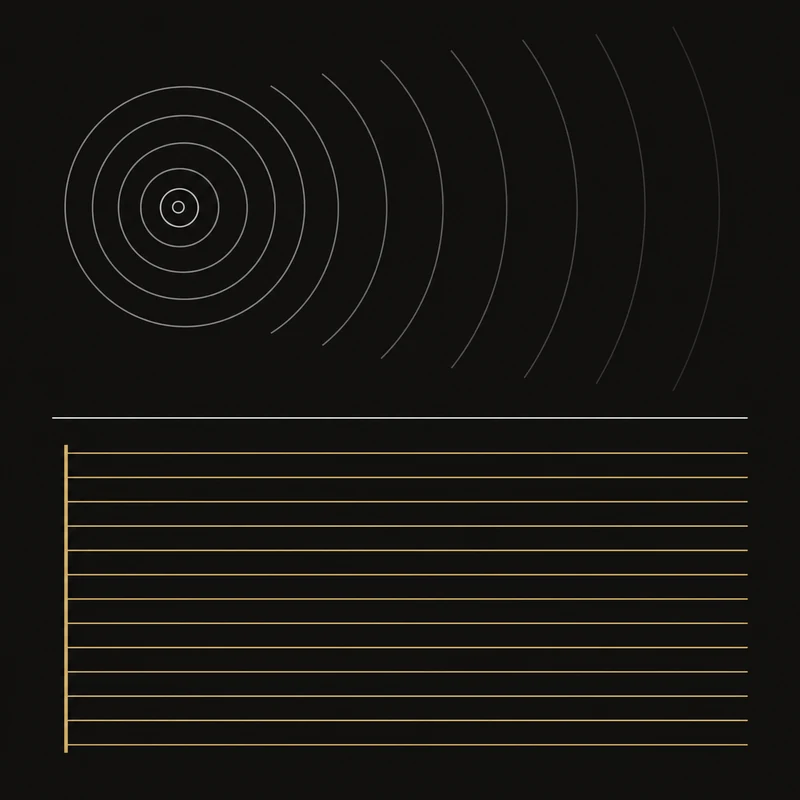
| Level nonuniformity | −6 dB per doubling of distance; hot spots and dead zones | Planar wavefront: roughly 5 dB lost between 1 m and 10 m, where a point source loses about 20 — the falloff behaviour is the claim here, not an absolute output figure | Measured / expected |
| Comb filtering from incoherent sources | Multiple cones interfering out of phase | A single coherent radiating surface reduces source-side interference. Room reflections remain — we do not claim otherwise | Illustrative simulation |
| Pressure to overdrive | Dead zones force a higher master level, driving more excursion and more distortion | Uniform coverage allows a lower level for equal intelligibility everywhere | Inference |
The honest chain, end to end
Lower distortion and uniform coverage → less signal reconstruction demanded of the auditory system → a smaller draw on the attention budget → an environment that does not tax the resource flow depends on. That is the entire legitimate content of Flow State Audio™, and it is sufficient. Nothing in this chain requires a claim about brain states, and the chain is stronger without one, because every link is either measured or clearly labeled as inference.
A Study We Invite
The gap between “labeled inference” and “measured” is closable. A modest, well-designed study would be more persuasive than any claim we could write, and we would rather fund the test than assert the conclusion.
| Element | Design |
|---|---|
| Structure | Within-subjects A/B, matched SPL at the listening position verified with a calibrated meter, matched programme material. Condition A: conventional point-source playback at high excursion. Condition B: Planar Matryxx™ array. Double-blind behind an acoustically transparent scrim. |
| Tasks | Sustained attention (SART or equivalent vigilance task) and reading comprehension, across 45–60 minute sessions with music or ambient playback. |
| Measures | Task-evoked pupillometry (the field-standard effort index), dual-task cost, NASA-TLX subjective workload, Flow Short Scale (FSS-2), optionally HRV. |
| Prediction | Equal comprehension, with lower pupil-indexed effort and lower subjective workload in condition B. |
Any outcome is publishable — including one that fails to support our inference. If you run a hearing-science, HCI or human-factors lab and this interests you, get in touch.
References
Listening effort & pupillometry
Pichora-Fuller, M. K., et al. (2016). Hearing impairment and cognitive energy: The Framework for Understanding Effortful Listening (FUEL). Ear and Hearing, 37, 5S–27S.
Zekveld, A. A., Kramer, S. E., & Festen, J. M. (2010). Pupil response as an indication of effortful listening. Ear and Hearing, 31(4), 480–490.
Koelewijn, T., et al. (2014); Zekveld, A. A., et al. (2014). Degradation type affects pupil response at matched intelligibility.
Obleser, J., et al. (2012). Adverse listening conditions and memory load drive a common alpha oscillatory network. Journal of Neuroscience, 32(36).
Zhang, Y., et al. (2020). Pupillary response to listening effort during a concurrent memory task. PLOS ONE, 15(5), e0233251.
Winn, M. B., et al. (2018). Best practices in pupillometry for listening effort. Trends in Hearing, 22.
Hornsby, B. W. Y. (2013). Subjective fatigue and effortful listening. Ear and Hearing, 34(5).
Noise & stress physiology
Basner, M., et al. (2014). Auditory and non-auditory effects of noise on health. The Lancet, 383(9925), 1325–1332.
Münzel, T., et al. (2018). Environmental noise exposure, oxidative stress and cardiovascular risk. Antioxidants & Redox Signaling, 28, 873–908.
Hahad, O., et al. (2019). Noise-induced stress hormones, oxidative stress, and vascular dysfunction. Oxidative Medicine and Cellular Longevity.
Schmidt, F. P., et al. (2013). Effect of night-time aircraft noise exposure on endothelial function. European Heart Journal.
WHO (2018). Environmental Noise Guidelines for the European Region.
Flow & attention
Csikszentmihalyi, M. (1990). Flow: The Psychology of Optimal Experience.
Kahneman, D. (1973). Attention and Effort.
Dietrich, A. (2004). Transient hypofrontality hypothesis. Consciousness and Cognition, 13(4).
Altmann, E. M., Trafton, J. G., & Hambrick, D. Z. (2014). Momentary interruptions derail the train of thought. JEP: General, 143(1).
EEG alpha and listening effort
Hughes, S. W., & Crunelli, V. (2005). Thalamic mechanisms of EEG alpha rhythms. The Neuroscientist, 11(4), 357–372.
Lopes da Silva, F. (1991). Neural mechanisms underlying brain waves. EEG and Clinical Neurophysiology, 79(2).
Binaural beats
Garcia-Argibay, M., Santed, M. A., & Reales, J. M. (2019). Efficacy of binaural auditory beats: a meta-analysis. Psychological Research, 83, 357–372.
Ingendoh, R. M., et al. (2023). Binaural beats to entrain the brain? A systematic review. PLOS ONE.
Orozco Perez, H. D., et al. (2020). Binaural beats weakly entrain cortical activity. eNeuro.
Acoustic environment, offices & the built environment
International WELL Building Institute. WELL Building Standard v2 — Sound concept. Features covering background noise levels, reverberation time, sound-reducing surfaces and acoustic zoning.
Jahncke, H., Hygge, S., Halin, N., Green, A. M., & Dimberg, K. (2011). Open-plan office noise: cognitive performance and restoration. Journal of Environmental Psychology, 31(4), 373–382.
Simulated-office research on open-plan noise and multimodal stress detection (2021), reporting raised heart rate and skin conductance without a matching drop in proofreading accuracy; summarised by the World Economic Forum, July 2021.
Mueller, B. J., Liebl, A., Herget, N., Kohler, D., & Leistner, P. (2022). Active noise-cancelling headphones in open-plan offices: no influence on cognitive performance but improved perceived privacy and acoustic environment. Frontiers in Built Environment, 8, 962462.
Interruption, attention residue & deep work
Mark, G., Gudith, D., & Klocke, U. (2008). The cost of interrupted work: more speed and stress. Proceedings of CHI 2008. Source of the widely cited ~23-minute return-to-task figure.
Leroy, S. (2009). Why is it so hard to do my work? The challenge of attention residue when switching between work tasks. Organizational Behavior and Human Decision Processes, 109(2), 168–181.
Newport, C. (2016). Deep Work: Rules for Focused Success in a Distracted World. Grand Central Publishing.
Distortion & perceived listening effort
Biberger, T., & Ewert, S. D. Audio quality perception for nonlinear distortions in complex acoustic environments. Trends in Hearing (2022, with later follow-up work).
Subjective and model-based assessment work linking nonlinear “musical noise” distortion to rated listening effort across the full scale, from no effort to extreme effort.
Wellness market context
Global Wellness Summit (2026). The Future of Wellness: 2026 Trends Report. See in particular “The Rise of Neurowellness” and “The Over-Optimization Backlash.”
Biofield claims
Rosa, L., et al. (1998). A close look at therapeutic touch. JAMA, 279(13), 1005–1010.
This page is an evidence review and editorial commentary. It is not medical advice. It describes no property of any Marziani product beyond acoustics. Product claims are limited to acoustics and attention as labeled above. Safe-listening limits apply to every playback system, including ours.