
MARZIANI InMERSION SYSTEMS™ — Technical Specification & Technology Report
The Technological Advantage: Planar Matryxx™ vs. Legacy Audio
The audio industry has historically relied on a fundamental acoustic compromise. Ordinary speaker technologies operate as point sources, projecting sound outward from a central cone. This creates inherent physical limitations: the output drops off aggressively with distance, collides with room acoustics, and results in uneven coverage. Audiences experience hot spots near the hardware, dead zones in the back, and a total lack of phase coherence across the venue.
Planar Matryxx™ technology (Patents Pending) eliminates the point-source compromise entirely. Engineered in two architectural variations—Planar Magnetic Matryxx™ (thin-film arrays) and Planar Dynamic Matryxx™ (proprietary full-range dynamic drivers)—the platform operates on the physics of total immersion.
The Superiority of the Coordinated Wavefront
Continuous “Sound Bath” Propagation
Rather than throwing sound at a room and hoping the acoustics cooperate, every panel in the array moves in phase as a single coordinated surface. This generates a planar, long-throw wavefront that propagates evenly across a room of any size.
Zero Acoustic Degradation
The wavefront delivers the exact same clarity, accuracy, loudness, and 4-dimensional depth to the front row as it does to the back wall.
Phase Coherence
Multiple drivers act as one unified instrument. Sound is not placed into the space; it becomes the space.
Architectural Integration
The ultra-thin footprint removes the need for bulky legacy cabinets, allowing systems to disappear into walls, ride vehicles, and soaring museum atriums without competing with the aesthetic environment. Because the array structure itself runs at very low vibration (Section 7), it can be flush-mounted directly into a wall, ceiling, or vehicle shell without transmitting its own buzz into the surrounding architecture.
Hardware Ecosystem & Technical Specifications
The MARZIANI InMERSION SYSTEMS™ hardware lineup is scaled to match the acoustic demands of any experiential space, from sprawling theme park pavilions to tightly constrained ride vehicles.
Avvolgente
The largest continuous field system, built for pavilions, main-stage attractions, and museum atriums where massive volumes of air must move synchronously. The modular panels scale to any footprint without losing phase coherence, delivering festival-level output without mechanical strain.
Product page → Category 02 · Modular FieldCampo
A flexible mid-size array engineered for multi-zone architectural designs. It provides strict acoustic containment, independently zoning gallery rooms and themed show scenes so each space receives its own complete sound field without audio bleeding into the next.
Product page → Category 03 · Focused PointNucleo
A compact, highly concentrated system designed for tight enclosures. It delivers the pristine coordinated-array clarity of the flagship systems but is scaled to mount directly inside moving attraction vehicles, isolated gallery alcoves, or small presentation stages.
Product page →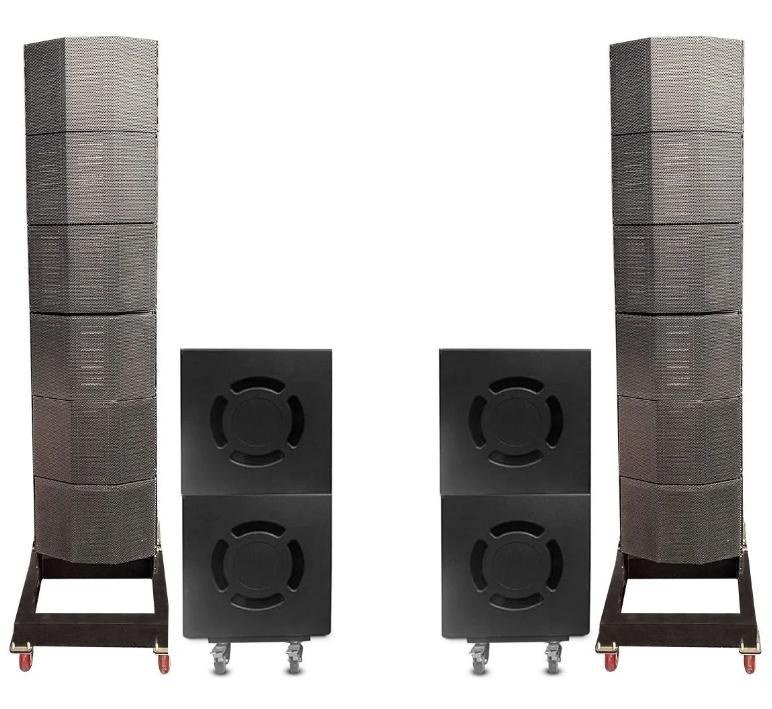
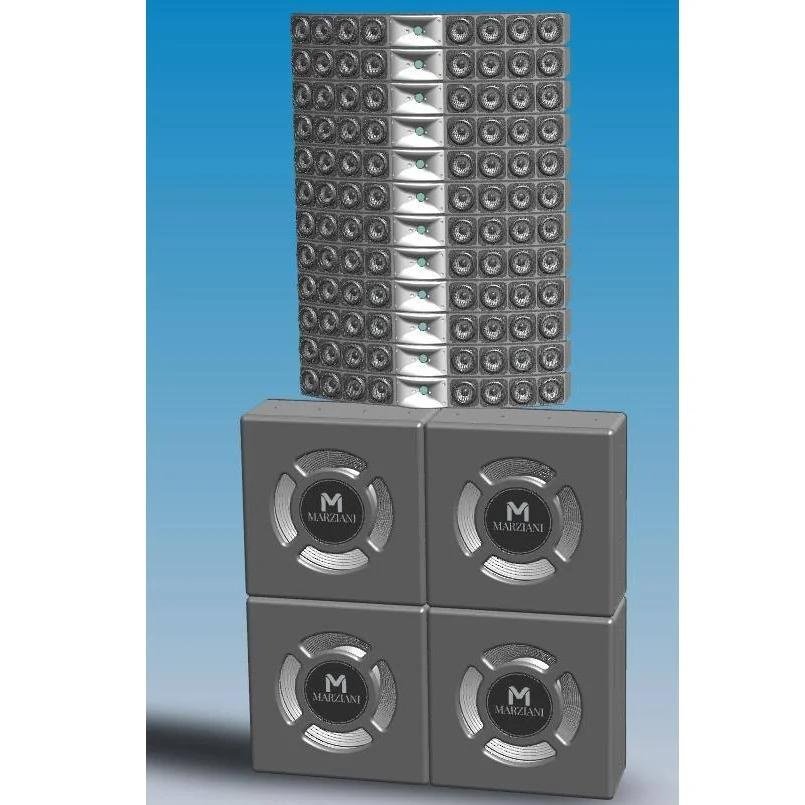
System Specification Matrix
| Specification | Avvolgente (Flagship) | Campo (Modular) | Nucleo (Focused) |
|---|---|---|---|
| Array Configuration | 12–48 modular panels (expandable) | Mid-size array (flexible zoning) | 1–4 panels (single-zone) |
| Recommended Footprint | Up to 60,000 sq ft | Mid-capacity venues | Up to 3,000 sq ft |
| Core Environments | Pavilions, museum atriums, main stages | Gallery rooms, themed show scenes | Ride vehicles, alcoves, small stages |
| Mounting Options | Suspended truss, wall-flush, ground-stack | Architectural integration | Vehicle-integrated, recessed, compact stand |
| Environment Rating | Indoor / weatherized outdoor | Indoor / isolated zones | Indoor / ride-vehicle rated |
| Duty Cycle | Continuous, multi-decade commercial rating | Continuous commercial rating | Continuous, high-cycle-count rated |
| Hardware Finish | Powder-coat black, custom architectural | Powder-coat black, custom architectural | Powder-coat black, custom match |
To understand exactly how Planar Matryxx™ can achieve extreme long-throw distances—such as sustaining a drop of only 5 dB over 900 feet or projecting a mile for military applications—we have to look at the fundamental acoustic physics of how the systems move air compared to legacy speakers.
The advantage comes down to wave propagation geometry and phase coherence.
The Physics of Legacy Audio: Spherical Propagation
Traditional speakers—no matter how large the cone or how powerful the amplifier—operate as point sources.
When a standard speaker cone pushes air, it generates a spherical sound wave that expands outward in all directions like a balloon inflating. Because the acoustic energy is constantly spreading over a rapidly expanding spherical surface area, it is subject to the Inverse Square Law.
In physics, the intensity I of a spherical wave decreases exponentially with the square of the distance r from the source:
Spherical propagation — intensity falls with the square of distance
Legacy point source — spherical decay
Planar Matryxx™ — flat sheet of sound
The 6 dB Penalty
In practical terms, this means a point-source speaker loses exactly 6 decibels of sound pressure level (SPL) every time the distance doubles.
The Overcompensation Flaw
To reach an audience 200 feet away with adequate volume, a traditional PA system must be driven at ear-damaging, distorted volumes (e.g., 115+ dB) at the source. It relies on brute force to overcome rapid acoustic decay.
The Marziani Advantage: Planar Wave Propagation
Planar Matryxx™ technology completely bypasses the Inverse Square Law by changing the shape of the sound wave itself.
Instead of a small cone pushing a high-pressure bubble, the system’s coordinated array moves a massive surface area of air simultaneously. Because every single diaphragm panel moves perfectly in phase, the system generates a planar wavefront (a flat sheet of sound) rather than a spherical one.
For a theoretically perfect planar wave, the acoustic energy does not diverge or spread out geometrically; it travels straight forward. Therefore, the intensity remains constant relative to the area A:
Planar propagation — intensity constant relative to area
Near-Zero Geometric Decay
Because the sound wave isn’t expanding outward in all directions, it doesn’t lose 6 dB per doubling of distance. The only significant SPL loss over massive distances (like 900 feet or a mile) comes from environmental factors like air friction and humidity, rather than geometric spreading.
The “Sound Bath” Reality
This is why the volume feels identical whether you are 10 feet or 100 feet away. The wavefront simply glides through the air as an intact, continuous sheet.
Corroborating measured figures — from the Technology page
Total Phase Coherence
Legacy long-throw systems try to cheat the Inverse Square Law by stacking dozens of point-source speakers into massive “line arrays.” However, this creates a new problem: the spherical waves from all those separate cones constantly collide with each other in mid-air.
Acoustic Collisions
These collisions cause destructive interference—frequencies cancel each other out, creating dead zones, muddy audio, and a loss of intelligibility over distance.
The Coordinated Instrument
Because Planar Matryxx™ treats every panel as one coordinated instrument, there are no colliding wavefronts. The system produces a highly directional, phase-coherent field that remains perfectly intact from the moment it leaves the transducer until it hits the back wall.
By eliminating the spherical divergence of the Inverse Square Law and maintaining perfect phase coherence, the technology allows you to cast highly intelligible, full-range audio over massive distances using a fraction of the power required by legacy PA titans.
To understand why Planar Matryxx™ arrays can power a massive venue using a standard 110V wall outlet—drawing less electrical current than a kitchen toaster—while legacy systems require heavy-gauge commercial distro and diesel generators, you have to look at how traditional speakers waste power.
Legacy PA systems are fundamentally inefficient; they are essentially electrical space heaters that happen to produce sound as a byproduct.
Here is the exact mechanical and acoustic physics breakdown of why MARZIANI InMERSION SYSTEMS™ requires only a fraction of a single watt of acoustic power to achieve what takes competitors thousands of watts.
Ultra-Low Mass vs. High Inertia (The Physics of Movement)
Traditional point-source speakers rely on heavy, moving parts: thick paper or Kevlar cones, heavy copper voice coils, and stiff rubber suspensions.
The Legacy Flaw
According to Newton’s Second Law of Motion (F = ma), accelerating a heavy mass requires a massive amount of force. To rapidly push and pull a heavy 12-inch or 18-inch cone thousands of times per second requires brutal amounts of electrical current—often 2400W of peak power per box.
The Marziani Solution
Planar Matryxx™ technology replaces the heavy cone and voice coil with a near-weightless, ultra-thin metal diaphragm (typically between 2 and 4 µm thick). Because the moving mass is practically zero, the system requires virtually zero electrical force to accelerate and decelerate the diaphragm.
Very Low, Not Zero, Structural Vibration
Planar Matryxx™ does not claim zero vibration of the array structure — only very low vibration, and the reason is mechanical, not marketing. Cone-and-piston drivers vibrate visibly because their diaphragms carry real mass; that moving mass is exactly what generates the sound, but it also generates a reaction force in the surrounding structure. Planar Matryxx™ uses a diaphragm of roughly 300 mg against a total transducer mass near 3 kg — a ratio of about 10,000 : 1. By F = m × a, that tiny moving mass produces a correspondingly tiny reaction force: enough to move air and generate the desired loudness, but not enough to meaningfully excite the much larger mass of the array structure around it.
Exponential Acoustic Coupling (102 dB Sensitivity)
In the audio world, sensitivity measures how efficiently a speaker converts electrical wattage into acoustic volume (measured at 1 Watt at 1 meter).
The Legacy Flaw
Standard commercial speakers generally hover around 85 dB to 90 dB sensitivity. Because decibels are logarithmic, every 3 dB increase requires double the amplifier power. Hitting 110 dB on an inefficient speaker requires an exponential surge in wattage.
The Marziani Solution
When dozens of Planar Matryxx™ panels are arrayed, they do not act as separate speakers; they acoustically couple into one massive, highly efficient engine. This coordinated array achieves a staggering ~102 dB sensitivity @ 1W/1m. This means the array generates concert-level volume using less than 1 Watt of actual acoustic draw. The remaining minimal power draw simply runs the baseline electronics and system processors.
Bypassing the Inverse Square Law “Overdrive” Penalty
As established, traditional spherical sound waves lose 6 dB of volume every time the distance to the listener doubles.
The Legacy Flaw
To deliver 90 dB of clear audio to a guest sitting 300 feet away, a traditional PA must blast an ear-damaging 130+ dB at the source. Pumping out that initial 130 dB requires massive, continuous high-voltage power.
The Marziani Solution
Because the planar wavefront travels as a coherent cylinder or flat sheet, it does not rapidly diverge. Measured over distance, the planar wavefront loses only about 5–6 dB across the first 10 meters, so the system never has to be “overdriven.” You do not need to burn thousands of watts to artificially blast the front row just to reach the back; a low-wattage, stable output at the source easily coasts to the back of the venue.
The Design Target, Stated Plainly
Marziani systems are engineered around a specific, sustained target: 110–115 dB of full-range, distortion-free coverage across the venue — not a peak figure pulled from a spec sheet. It has become common in the industry to see systems advertised at 144–150 dB max output; figures in that range are not a meaningful quality signal, and approaching them exposes an audience to levels capable of causing real hearing damage.
Room Artifacts at Overdriven SPL
Past a certain SPL threshold, a room stops being a passive container for sound and starts contributing its own noise: windows and doors rattle, roof and structural elements resonate, light fixtures buzz. That structure-borne noise layers onto the program material and makes the overall sound noticeably dirtier. Because a Planar Matryxx™ array never needs the same near-field overdrive to cover a room, this effect is minimized or absent entirely.
SPL drop-off vs. distance is a logarithmic function.
Zero Energy Wasted on Phase Cancellation
The Legacy Flaw
When an installation uses distributed point-source speakers (like dozens of pendants hung from a ceiling or stacked in a line array), their expanding spherical waves constantly collide in mid-air. When these waves collide out of phase, they cancel each other out. The amplifier is burning electrical power to generate sound waves that literally destroy each other before reaching the listener’s ear.
The Marziani Solution
A Planar Matryxx™ field moves as one perfectly coordinated, phase-aligned surface. There are no colliding waves and no destructive interference. Because the array radiates as one phase-aligned surface, essentially all of the acoustic energy it produces is directed at the audience instead of being cancelled by interference — no power is wasted fighting itself.
The Financial & Operational Reality (Expanded ROI)
This extreme acoustic efficiency changes the financial realities of venue infrastructure and touring logistics. While legacy systems force clients to trench concrete for high-voltage copper lines, hire commercial electricians, or rent diesel generators for outdoor events, a Marziani continuous field system simply plugs into the wall — eliminating the need for heavy audio distro and turning acoustic efficiency into a hard-dollar operational advantage.
The “Zero-Distro” Infrastructure Advantage (Permanent Installs)
When permanently integrating a large legacy audio system into a pavilion, museum, or indoor venue, the primary financial burden is usually not the hardware itself — it is the heavy electrical infrastructure required to support it. Powering a traditional point-source rig capable of covering a large venue typically requires dedicated 20A or 30A circuits to handle peak current spikes without tripping breakers, which in turn means commercial electrical contracting, trenched conduit, and heavy-gauge copper wiring.
The Legacy Cost
In a market like Los Angeles, commercial electrician rates commonly run $50–$130 per hour, and retrofitting a large venue with dedicated high-voltage circuits and heavy-gauge conduit routinely runs $15,000–$25,000+ in electrical infrastructure before a legacy system is even turned on — on top of the ongoing grid draw of running an always-hungry rig across a full event schedule.
The Marziani Approach
Because the array acoustically couples to a high overall sensitivity, a continuous field system’s acoustic draw is a small fraction of a watt. The entire flagship Avvolgente rig can run from existing, standard 110V wall outlets — eliminating the need for trenching, heavy copper, and specialized commercial electrical contracting entirely.
Generator Cost Elimination (Touring & Outdoor)
When operating off-grid for outdoor festivals, stadium gigs, or touring acts, powering a large-format legacy line array requires continuous, high-voltage power delivered by synchronized generator trailers — along with the rental, fuel, and crew costs that come with them.
The Legacy Cost
A touring-grade, sound-attenuated generator trailer capable of the job commonly rents in the range of $2,000–$2,500 per day, with fuel consumption on the order of several thousand dollars more across a multi-month touring season — a recurring cost that scales with every date on the calendar.
The Marziani Approach
Because of the array’s high sensitivity and near-zero moving mass, a Marziani continuous field system’s actual acoustic draw stays under a watt, with the rig able to run off standard 110V site power or compact portable battery stations — removing the generator line item from the touring budget entirely.
Modeled example — illustrative, not a quote · supplied directly by MARZIANI InMERSION SYSTEMS™
These figures model one representative Los Angeles-market scenario. Actual costs vary by market, venue, utility rates, and scope of work — treat them as a starting point for your own estimate, not a guaranteed number.
AI-Engineered Array Control
To hold a continuous, perfectly coordinated wavefront across a large architectural array, the timing and signal distribution between dozens of individual drivers has to be exact. Rather than relying on off-the-shelf DSP software, Planar Matryxx™ arrays are governed by a proprietary control architecture built with the help of artificial intelligence — developed with an engineering partner with more than 25 years of specialized AI expertise, purpose-built to manage the array’s acoustic tolerances.
“Set and Forget” Reliability
In high-stakes commercial environments — a theme park ride vehicle or a live main stage — operators cannot risk a dynamic, machine-learning system unpredictably altering the sound or behaving erratically mid-show. AI was used to build and optimize the array management software during development; the software that ships is not a live, continuously-learning system. It is compiled and pre-programmed directly into the hardware, operating as a locked, deterministic system with strictly limited operational latitude — so behavior stays exactly as designed, every time.
Simultaneous Driver Synchronization
The resulting control software delivers the same acoustic signal to every driver across the array at essentially the same instant, eliminating micro-delays and letting the entire flat plane push air perfectly in phase — the coordination that the coordinated-wavefront physics described in Sections 1–10 depends on.
The distinction matters: AI is a tool used once, during engineering, to build a better deterministic controller — not a live system making decisions in the room. That is what makes it dependable enough for a show that can't afford a surprise.
The Human Experience: Immersion Without Fatigue
Supplied directly by MARZIANI InMERSION SYSTEMS™ · not part of Technical Report 11
Everything in the sections above converges on one experience that conventional approaches—point source and line array alike—are not architected to deliver: full-volume immersion that your ears never have to fight. It follows directly from the array geometry rather than from tuning.
It is the signature of the Planar Matryxx™ platform, and it is the difference between audio you stand in front of and an environment you feel you are inside of.
Dramatically Less Eardrum Fatigue
Legacy systems reach volume through brute force—overdriven cones, harmonic distortion, and colliding wavefronts that hammer the ear with harsh, chaotic peaks. That harshness is what makes loud audio exhausting. The Planar Matryxx™ field arrives as one clean, phase-coherent sheet: no distortion spikes, no interference artifacts, no front-row blast zones. Guests stay comfortably inside full-volume immersion far longer, with dramatically less eardrum fatigue.
Normal Conversation at Full Volume
Full concert. Full conversation. That's Planar Matryxx™. Because the sound bath is perfectly even and perfectly clean—and because the array never has to overdrive the front just to cover the back—it never has to shout over its own distortion to feel powerful. Guests standing inside a full-volume show scene can turn to one another and speak at a completely normal level—and be clearly understood—while the immersive field continues at full presence around them. See the Technology page for the full explanation.
Headroom to Turn It Down
Because clarity holds up well below a system’s ceiling, an operator doesn’t have to push levels as high to be heard clearly — and running a system quieter, whatever the system, is generally kinder to hearing over a long day. This is a practical byproduct of low distortion, not a claim that any SPL becomes risk-free; standard exposure guidance and hearing protection still apply. See the Technology page for the full explanation.
Why only this platform can do it — as established above
When the ears relax and conversation flows inside the field, the sound stops being something you listen to—it becomes a place you are inside of. That is true immersion, and it is what MARZIANI InMERSION SYSTEMS™ is engineered to deliver.