
Marziani© Songo
A state-of-the-art 2.1 nearfield desktop playback system that scales seamlessly into large-format spatial configurations — engineered for mixing engineers, mastering professionals, and audiophiles who need absolute precision in the frequency, phase, and time domains, without the acoustic artifacts of traditional boxed point-source speakers.
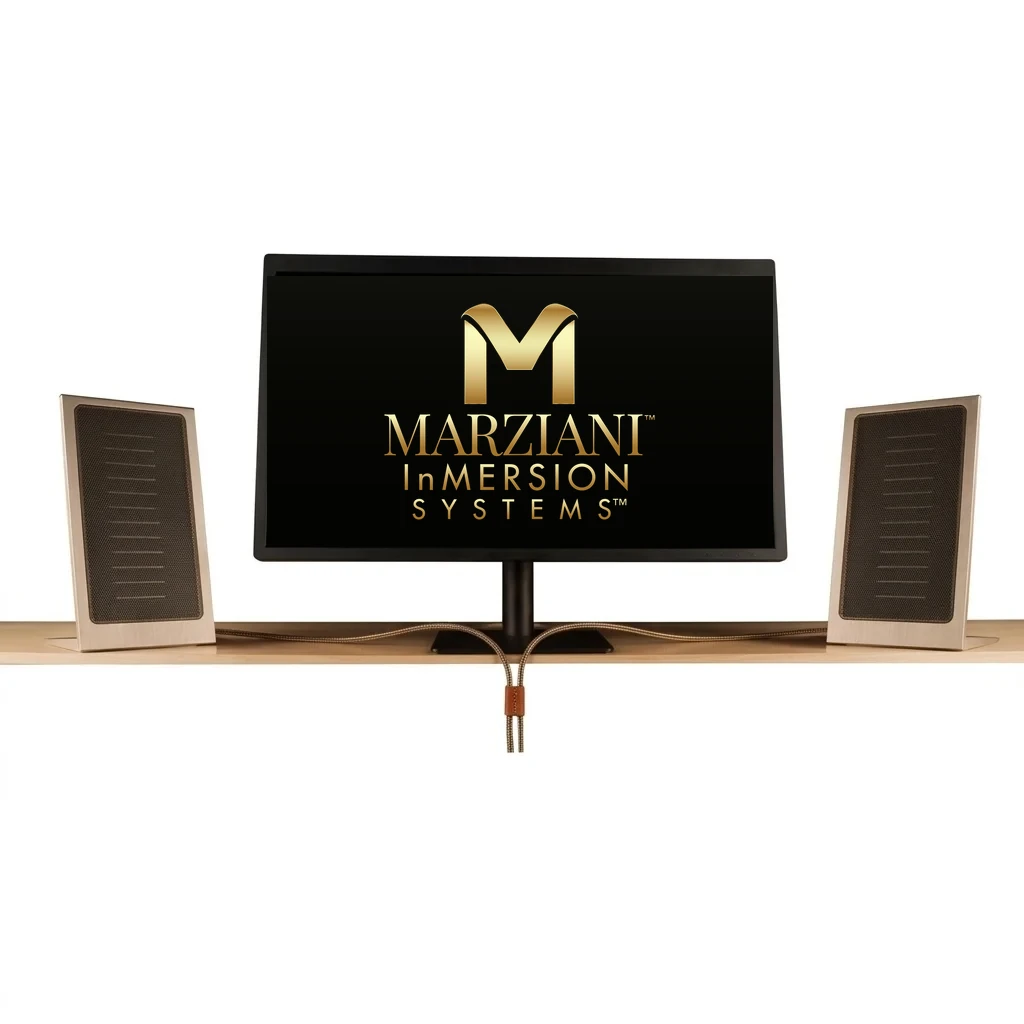
Four pieces. One coherent instrument.
Two Planar Magnetic Satellites
High-efficiency dipole arrays built on a miniaturized version of Planar Matryxx™ technology.
Songo SB-8P Subwoofer
A compact, active bass module that extends the system smoothly down to 30 Hz.
Songo MD-4 Amplifier
A 4-channel Class-D amplifier with a heavily programmable internal DSP engine.
Songo SHD Preamplifier / Streamer
A digital front-end with Dirac Live room correction, a Volumio network streamer, and a dedicated headphone amplifier.
A miniaturized Matryxx, tuned for the nearfield.
The Songo satellites use a miniaturized version of our Planar Matryxx™ technology to achieve a phase-coherent, near-zero-distortion sound field. Each satellite is a dipole planar magnetic transducer: a 5″ × 10″ (125 × 250 mm) driver housed in an ultra-rigid, machined aluminum frame.
The diaphragm is an aerospace-grade polyimide film just 1.8 microns thick. That ultra-light mass keeps the response linear without ever needing to be driven past a high power threshold — which is why the system stays free from listening fatigue at any SPL.
The magnetic circuit uses sintered, high-temperature N48H neodymium magnets arranged in a proprietary push-pull dual-pole configuration, achieving an peak induction flux density of 1.8 Tesla.
Dipole planar magnetic · 5″ × 10″ (125 × 250 mm) driver · machined aluminum frame · 1.8-micron aerospace polyimide diaphragm · sintered N48H neodymium · push-pull dual-pole circuit · 1.8 T peak induction flux
Satellite specifications.
| Sensitivity | 100 dB / 1 W / 1 m (upper midrange) |
| Maximum SPL | >120 dB at 1 meter |
| Frequency range | 200 Hz – 50 kHz |
| Total harmonic distortion | < 0.5% at 100 dB |
| Crossover to subwoofer | 200 Hz |
Purpose-built electronics for a dipole array.
Because the Songo satellites are dipole planar arrays, they require specific electronic management — crossing over to the subwoofer and equalizing the natural roll-off of an unbaffled panel. The MD-4 and SHD handle both.
Songo MD-4 Amplifier
4-Channel UMAC Class D · 93% Efficiency- 245 W RMS per channel into 8 Ω (at 1% THD)
- MATLAB-based visual programmable DSP (Audioweaver) with 140 parametric filters for crossover design, equalization, and calibration
- AKM Velvet Sound D/A conversion for exceptionally low noise
- Balanced XLR, AES/EBU, S/PDIF, and USB Type-B inputs
- Outputs to the satellites via 4-pole Speakon connectors
Songo SHD Studio Digital Preamplifier
Digital Front-End · Dirac Live Room Correction- Analog Devices 450 MHz DSP running the Dirac Live digital room correction algorithm
- Supplied UMIK-1 calibration microphone — corrects frequency and phase anomalies specific to your room
- AES/EBU, S/PDIF, TOSLINK, and USB inputs
- Built-in Volumio network streamer
- Dedicated headphone amplifier
The SB-8P: down to 30 Hz.
Below the 200 Hz crossover point of the planar satellites, the SB-8P active subwoofer takes over — an 8-inch high-excursion driver paired with an 8-inch passive radiator, powered by an internal 180 W Class AB amplifier and tuned to extend the system’s low end smoothly down to 30 Hz.
Runs a studio on a standard wall outlet.
In a professional studio, power infrastructure dictates system integration — and Songo’s Planar Matryxx™ technology creates a massive efficiency divide compared to legacy master monitors and heavy commercial systems built on high-mass cones.
Near-zero acoustic draw. The MD-4 provides an immense 245 W of dynamic headroom per channel — but because the satellites pair an ultra-light 1.8-micron diaphragm with 100 dB sensitivity, normal nearfield listening levels of 80–90 dB require less than 1 watt of continuous acoustic power.
The 110 V reality. The planar satellites demand virtually no electrical current, so the combined draw of the arrays and the 180 W SB-8P stays astonishingly low. Even under extreme transient peaks, the entire system runs off a standard 15-amp, 110 V wall outlet — without ever risking a tripped breaker or requiring power conditioning.
Scaling for Atmos. That efficiency becomes a critical advantage when a studio grows from stereo mixing into immersive spatial audio, such as 7.1.4 or 9.1.6 Dolby Atmos configurations. The traditional route — heavy master monitors from brands like ATC, PMC, or Augspurger, or high-output systems like the JBL M2, a 15-inch two-way master reference monitor that JBL specifies with a dedicated Crown I-Tech 5000HD delivering 1,200 watts into 8 Ω per speaker — forces facilities powering a 12-to-16-speaker array to trench dedicated 20-amp, high-voltage, or 220 V commercial lines. By contrast, a facility can deploy a dozen Songo planar arrays to create a flawless Atmos sound field at a fraction of that electrical footprint — driven aggressively while still comfortably riding standard 110 V site power, entirely bypassing severe electrical retrofitting.
Built for rooms like these.
Mixing & mastering suites
Absolute precision in the frequency, phase, and time domains — for decisions that have to translate everywhere.
Audiophile desktops
Fatigue-free listening at any SPL, with a network streamer and dedicated headphone amp built into the SHD front-end.
Immersive Atmos rooms
Scale from a stereo pair to a 7.1.4 or 9.1.6 spatial array without rewiring the building.
Hear the nearfield, redefined.
Tell us about your room — stereo desk or full spatial suite — and we’ll configure the system for it.
Request Pricing